> For the complete documentation index, see [llms.txt](https://features.scnd.com/llms.txt). Markdown versions of documentation pages are available by appending `.md` to page URLs; this page is available as [Markdown](https://features.scnd.com/v2.0/dashboards/user-dashboard-structure-pages.md).
# User dashboard structure pages
Understanding how to use the different user interface components
{% hint style="info" %}
Path: Dashboard
{% endhint %}
* [Definition](#id-1.14.x-userdashboardstructurepages-definition)
* [Create an interface structure](#id-1.14.x-userdashboardstructurepages-createaninterfacestructure)
* [Read an interface structure in the dashboard](#id-1.14.x-userdashboardstructurepages-readaninterfacestructureinthedashboard)
* [Overview of the interface](#id-1.14.x-userdashboardstructurepages-overviewoftheinterface)
* [Navigation bar](#id-1.14.x-userdashboardstructurepages-navigationbar)
* [The platform logo](#id-1.14.x-userdashboardstructurepages-theplatformlogo)
* [The search bar](#id-1.14.x-userdashboardstructurepages-thesearchbar)
* [The user avatar](#id-1.14.x-userdashboardstructurepages-theuseravatar)
* [Publish your listing](#id-1.14.x-userdashboardstructurepages-publishyourlisting)
* [The hamburger menu](#id-1.14.x-userdashboardstructurepages-thehamburgermenu)
* [Side menu](#id-1.14.x-userdashboardstructurepages-sidemenu)
* [User card](#id-1.14.x-userdashboardstructurepages-usercard)
* [Breadcrumb](#id-1.14.x-userdashboardstructurepages-breadcrumb)
* [Update an interface structure](#id-1.14.x-userdashboardstructurepages-updateaninterfacestructure)
* [Update the user card](#id-1.14.x-userdashboardstructurepages-updatetheusercard)
* [Delete an interface structure](#id-1.14.x-userdashboardstructurepages-deleteaninterfacestructure)
* [Related resources](#id-1.14.x-userdashboardstructurepages-relatedresources)
## Definition
Several interface structure elements are available throughout the user dashboard. These elements help make user navigation more fluid.
**WHO CAN USE THIS FEATURE?**
**Switch users:** All logged-in users
**Non-Switch users:** All logged-in vendors
**Non-Switch users:** All logged-in customers
## Create an interface structure
New elements cannot be created from the user dashboard’s interface.
## Read an interface structure in the dashboard
### Overview of the interface
The user dashboard starts with a summary dashboard (figure 1).
Each structure element is described below.
Figure 1
### Navigation bar
The navigation bar (navbar) is located at the top of the page (figure 2)
Figure 2
The navbar is made of:
#### The platform logo
The platform’s logo (figure 3) is visible to all users. The operator can set in SBO > Other > Features > Platform Configuration > Platform Logo
Figure 3
#### The search bar
The search bar (figure 4.1) allows users to perform a quick search directly from their dashboard.
Figure 4.1
Clicking the search bar opens the full search engine (figure 4.2).
Instructions on how to use the search engine are provided here: [Vendor Homepage](https://features.scnd.com/v2.0/dashboards/pages/j408ofn9tasE3TFcGqJM#id-1.16.x-homepage-basicsolution-searchbar) or [Customer Homepage](https://features.scnd.com/v2.0/dashboards/pages/feSB3mgDIfY616Lvofu0#id-1.16.x-homepage-basicsolution-searchbar)
Figure 4.2
#### The user avatar
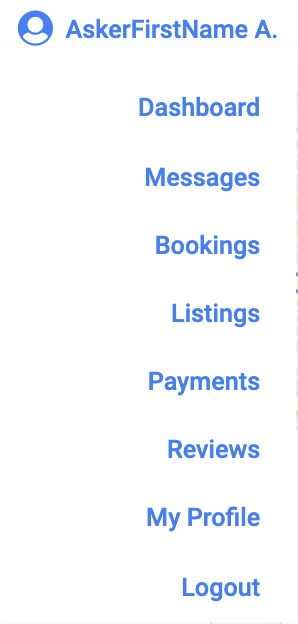
The user avatar (figure 5.1) is the access point to the user dashboard’s quick menu (figure 5.2). It is opened by clicking the user name. Logging out is done through this quick menu.
figure 5.1
figure 5.2
#### Become a Customer or Vendor
The "Become a vendor" or "Become a customer" button directs users to the main homepage, where they can initiate various actions. For vendors, this includes publishing listings, and for customers, creating requests for proposals (RFPs).
Figure 5.3
Figure 5.4
#### The hamburger menu
The hamburger menu (figure 7.1) displays content pages set by the administrator. The hamburger menu opens with a single click (figure 7.2 ).
figure 7.1
figure 7.2
### Side menu
The side menu (figure 8) is located on the left-hand side of the page. It offers smooth navigation and clear visibility through the user dashboard interface.
figure 8
The user dashboard’s multiple sections are accessible through the side menu:
* *Dashboard*: The user dashboard homepage, displays the user’s KPIs
* *Messages*: Access all messages sent/received by the user
* *Bookings*: Access all booking requests made/received by the user
* *Listings*: (Active only for offeror roles) Access all listings created by the user
* *Payments*: Access all purchases/sales made by the user
* *Reviews*: Access all reviews made/received by the user
* *My profile*: Update user profile information (identity information, payment details, personal data management tools)
{% hint style="info" %} Some sections may vary according to the user’s role in the non-switch platform:
* Listings: not available for asker-only users
* Payments:
* Only purchases are displayed for asker-only users
* Only payments received are displayed for offeror-only users
{% endhint %}
### User card
The user card is available throughout the user dashboard on the right side of each page (figure 9).
figure 9
This card displays:
* The set user location on a map
* The user’s profile picture
* The user’s registration date
* The user’s information verification status (Email, ID)
* The number of bookings completed as an offeror
* The user’s legal status (individual or company)
### Breadcrumb
A detailed breadcrumb is displayed on each page of the user dashboard (figure 10). It helps users understand the navigation path in the dashboard and gives them quick access to higher-ranked pages.
figure 10
## Update an interface structure
### Update the user card
A user can edit the information displayed on his user card through the “*Edit your profile”* button (figure 11). This redirects the user to the “My profile” page. The process is detailed here: [Profile pages](/v2.0/front-office/profile-pages.md)
figure 11
## Delete an interface structure
Deletion of an interface structure is not possible by any user or administrator.
## Related resources
**SBO:**
* [Settings](/v2.0/superadmin/settings.md)
**Front :**
* [Vendor Homepage](/v2.0/front-office/homepage/vendor-homepage.md)
* [Customer Homepage](/v2.0/front-office/homepage/customer-homepage.md)
* [Listing deposit (Time-Based rendering type)](/v2.0/front-office/rendering-types/commoditized-rendering-types/time-based/create-a-listing-time-based.md)
* [Profile pages](/v2.0/front-office/profile-pages.md)
**All business rules:**
* [Business rules](/v2.0/core-concepts.md)
---
# Agent Instructions
This documentation is published with GitBook. GitBook is the documentation platform designed so that both humans and AI agents can read, navigate, and reason over technical content effectively. Learn more at gitbook.com.
## Querying This Documentation
If you need additional information that is not directly available in this page, you can query the documentation by asking a question.
Perform an HTTP GET request on the following URL with the `ask` and `goal` query parameters:
```
GET https://features.scnd.com/v2.0/dashboards/user-dashboard-structure-pages.md?ask=&goal=
```
`ask` is the immediate question: it should be specific, self-contained, and written in natural language.
`goal` is what the user is ultimately trying to achieve, the reason they need the answer. Sharing it helps GitBook give you a better, more relevant answer. A goal is most helpful when it describes the outcome the user wants rather than restating the question. For example, with `ask=how do I create an API token`, a goal like `automate deployments from our CI pipeline` lets GitBook tailor the answer to that use case.
The response will contain a direct answer to the question and relevant excerpts and sources from the documentation.
Use this mechanism when the answer is not explicitly present in the current page, you need clarification or additional context, or you want to retrieve related documentation sections.