> For the complete documentation index, see [llms.txt](https://features.scnd.com/llms.txt). Markdown versions of documentation pages are available by appending `.md` to page URLs; this page is available as [Markdown](https://features.scnd.com/v2.0/core-concepts/google-tools.md).
# Google Tools
To analyse users data of your platform
* [Why](#id-1.14.x-googletools-businessrules-why)
* [Google analytics](#id-1.14.x-googletools-businessrules-googleanalytics)
* [Google tag manager](#id-1.14.x-googletools-businessrules-googletagmanager)
* [Which context](#id-1.14.x-googletools-businessrules-whichcontext)
* [Interfaces](#id-1.14.x-googletools-businessrules-interfaces)
* [Google tag manager](#id-1.14.x-googletools-businessrules-googletagmanager.1)
* [Google analytics](#id-1.14.x-googletools-businessrules-googleanalytics.1)
* [Configurations](#id-1.14.x-googletools-businessrules-configurations)
* [Steps to reproduce to set Google tools](#id-1.14.x-googletools-businessrules-stepstoreproducetosetgoogletools)
* [Cookie Bot Manager](#id-1.14.x-googletools-businessrules-cookiebotmanager)
* [Google Tag Manager](#id-1.14.x-googletools-businessrules-googletagmanager-1)
* [Google Analytics](#id-1.14.x-googletools-businessrules-googleanalytics-1)
## Why
### Google Analytics
Google analytics is a free website analysis dashboard. It gives you access to a range of insights about your website and the people who visit it.
### Google tag manager
Google tag manager is a free tool to manage your tag. It has been designed for website traffic analysis and marketing optimization. It allows you to quickly and easily update tags and code snippets on all pages of a website.
Google tag manager will allow you to manage other google tools to write scripts easily in your code and run them.
You will need a cookie manager cause now it is required to be followed. If the user does not accept the cookie the traffic will be not followed by google analytics.
## Which context
You can use it on every platform. When a platform operator needs to understand the users behavior and wants some data to create and manage marketing operations.
## Interfaces
### Google tag manager
{% hint style="info" %}
Link:
{% endhint %}
### Google Analytics
{% hint style="info" %}
Link: [https://analytics.google.com](https://analytics.google.com/)
{% endhint %}
## Configurations
In the SBO you will have to configure all these parameters to be able to use google analytics.
{% hint style="info" %}
Path: SBO > Others > Parameters
{% endhint %}
* SBO > Other > Feature > Core > **Google Tag Manager ID**: The google tag manager ID is: GTM - XXXX
* SBO > Other > Feature > Core > **CookieBot API key**
* SBO > Other > Feature > Core > **CookieBot ID**
## Steps to reproduce to set Google tools
### Cookie Bot Manager
The cookie bot manager is required to have access to send data to google tools, if the users do not accept cookies, tools will not be able to receive the values and store analyze them.
First, you will have to fill in the cookies parameters.
* **cocorico\_core.cookiebot\_api\_key**: Your cookie bot key
* **cocorico\_core.cookiebot\_id**: Your cookie bot ID
### Google Tag Manager
1. Create or log in on google tag manager with your google account (figure 1.2)
2. Create a google tag manager account (figure 1.2), by filling:
* Your account name
* Your country
* Container name
* Select the Web target platform
figure 1.1
figure 1.2
3\. Keep the Google tag Manager ID, you can find it in the navigation bar (figure 2):
You will have to fill the parameter, in the SBO (figure 3.1 & 3.2) :
* **cocorico\_shop.google\_tag\_manager**

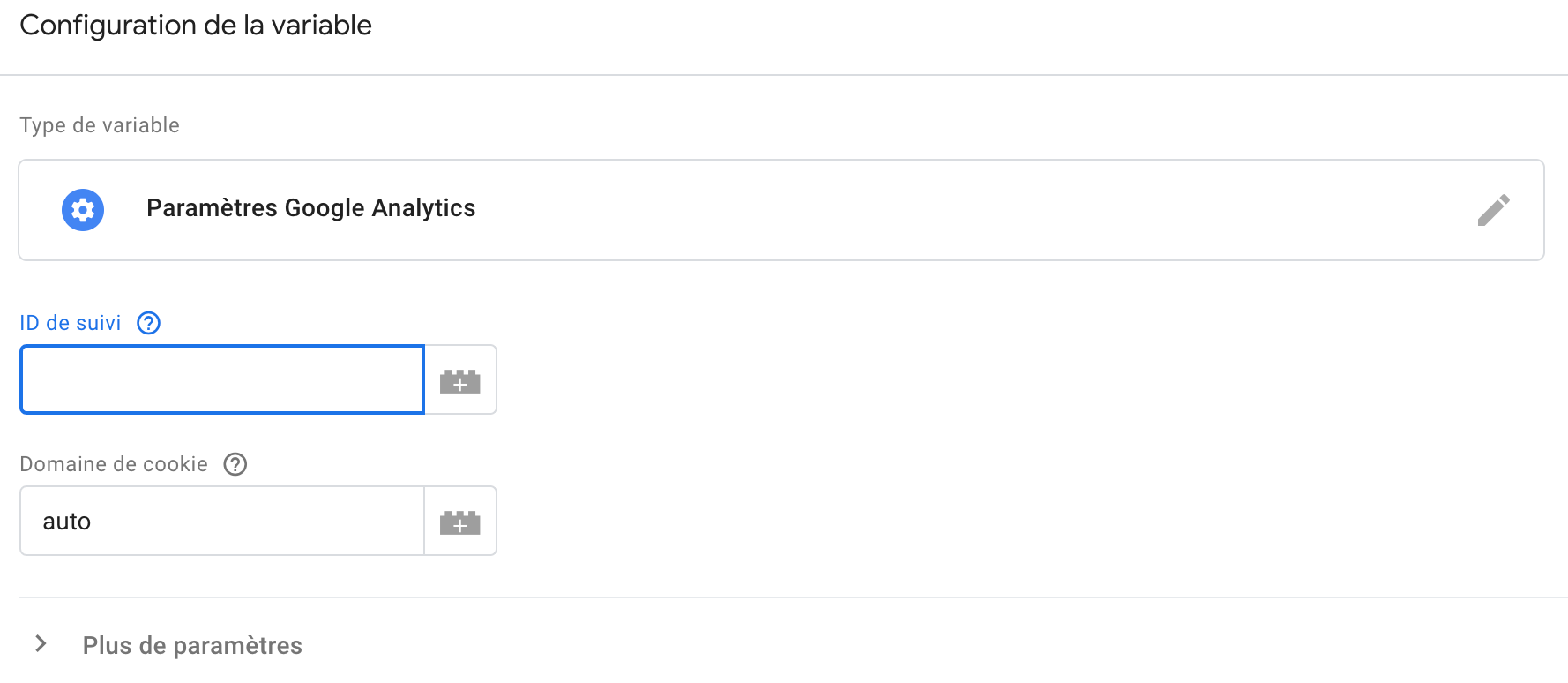
4\. Create a balize to connect google analytics to google tag (figure 4.1 & 4.2)
* Go to Tag in the sidebar menu
* Click on New
* Set: the name of the tag
* Choose the Tag type: Google Analytics: Universal Analytics
{% hint style="info" %}
It is important to choose the “Google Analytics: Universal Analytics”, otherwise it will not works
{% endhint %}
* Type of monitoring:
* Google Analytics parameters
* The ID of follow-ups that correspond to the Google analytics ID
* Cookie domain
figure 4.1
figure 4.2
Once all the fields are filled, save the tag you just created, in Google tag manager dashboard you should see the number of tags you created.
5\. Send your tags
You will have to send your tags, by clicking on the button send in the navigation bar, to make it works.
You will have to fill :
* The name of the version
* The description of the version
### Google Analytics
1. Create or log in on google tag manager with your google account (figure 5)

2. Create a google analytics account by filling (figure 6):
* Fill in the account name and check the checkboxes of: “Account data sharing settings”

* Fill in the website name, the timezone, and the currency (figure 7)

* Choose a sector
* Select the platform, which is Web
* Fill in the URL and name the flux
3\. Keep the measurement ID, and fill it in the parameters of the SBO
---
# Agent Instructions
This documentation is published with GitBook. GitBook is the documentation platform designed so that both humans and AI agents can read, navigate, and reason over technical content effectively. Learn more at gitbook.com.
## Querying This Documentation
If you need additional information that is not directly available in this page, you can query the documentation dynamically by asking a question.
Perform an HTTP GET request on the current page URL with the `ask` query parameter, and the optional `goal` query parameter:
```
GET https://features.scnd.com/v2.0/core-concepts/google-tools.md?ask=&goal=
```
`ask` is the immediate question: it should be specific, self-contained, and written in natural language.
`goal` is optional and describes the broader end goal you are ultimately trying to accomplish on behalf of the user. GitBook uses it to tailor the answer towards what is most useful for that goal.
The response will contain a direct answer to the question and relevant excerpts and sources from the documentation.
Use this mechanism when the answer is not explicitly present in the current page, you need clarification or additional context, or you want to retrieve related documentation sections.