> For the complete documentation index, see [llms.txt](https://features.scnd.com/llms.txt). Markdown versions of documentation pages are available by appending `.md` to page URLs; this page is available as [Markdown](https://features.scnd.com/v2.0/superadmin/users/user-categories-management.md).
# User categories management
User Categories help group the users of your platform in searchable verticals
{% hint style="info" %} Path: SBO > Users > Categories
{% endhint %}
{% hint style="warning" %} User categories are similar to listing categories.
{% endhint %}
* [Definition](#id-1.16.x-usercategoriesmanagement-definition)
* [Create user categories](#id-1.16.x-usercategoriesmanagement-createusercategories)
* [Read user categories](#id-1.16.x-usercategoriesmanagement-readusercategories)
* [Update the user’s categories](#id-1.16.x-usercategoriesmanagement-updatetheuserscategories)
* [Edit a user category](#edit-a-user-category)
* [Manage user categories hierarchy](#manage-user-categories-hierarchy)
* [Delete user categories](#id-1.16.x-usercategoriesmanagement-deleteusercategories)
* [Related resources](#id-1.16.x-usercategoriesmanagement-relatedresources)
## Definition
User category groups together users according to specific criteria.
**What is it used for?**
* It is used to classify users into a searchable category.
* Categorizing users allows other users to find relevant profiles through the platform.
WHO CAN USE THIS FEATURE?
Authorized administrators can use the user categories management tool.
## Create user categories
An authorized administrator can create user categories through the SBO’s Category sub-menu available in the User menu.
Super-administrator and administrators can add a new user category by clicking ‘*Add a category’ (figure 1)*.
Figure 1
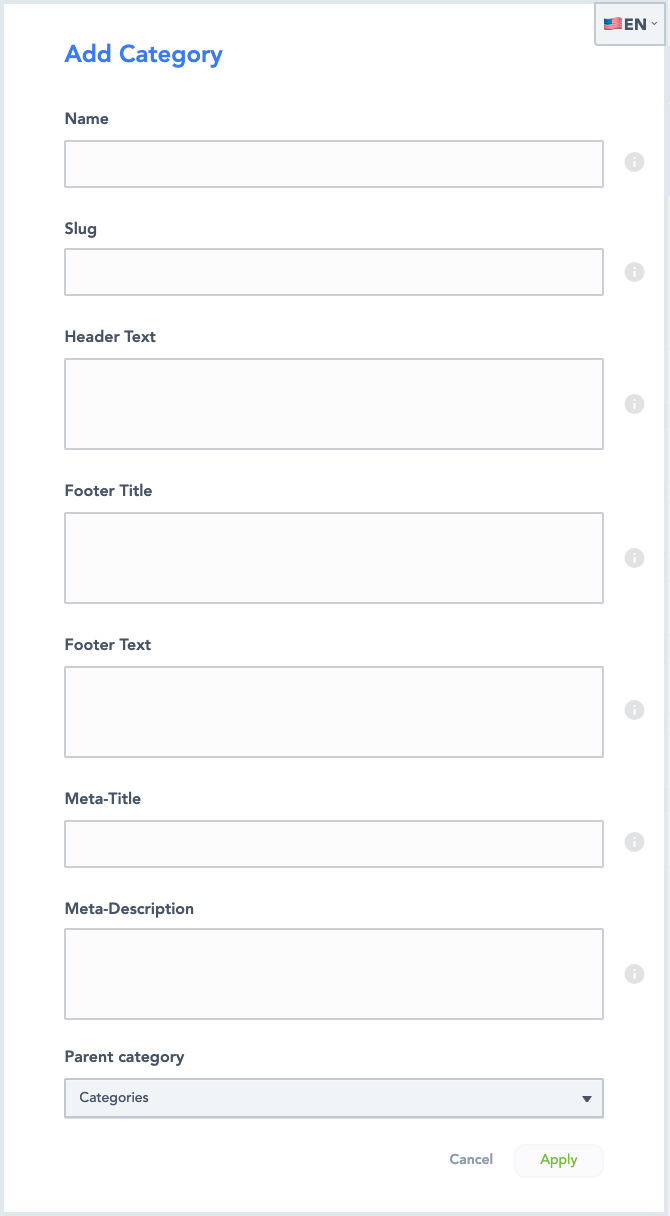
A pop-up opens and prompts the super-administrator or administrators to fill out the following information (figure 2).
Figure 2
{% hint style="success" %} A tooltip is available for each field. The tooltip’s content can be edited by authorized administrators.
{% endhint %}
* **Name**: The category’s name
{% hint style="warning" %} Only the category name is mandatory
{% endhint %}
* **Slug:** Set of words that will make up the search’s URL link. For SEO purposes.
{% hint style="info" %} A slug is automatically generated by default based on the category’s name.
{% endhint %}
* **Header Text:** Short text describing the category. It is displayed at the top of the user search results when a category is selected.
* **Footer Title**: Title before the footer text at the bottom of the user search results when a category is selected.
* **Footer Text**: Category description displayed at the bottom of the user search results when a category is selected.
* **Meta-Title**: Useful for SEO purposes, the meta-title is the browser tab’s title.
* **Meta-Description:** It goes hand in hand with the meta-title. Also useful for SEO purposes.
* **Parent Category:** Defines the category’s hierarchy level.
Click *“Apply*” (figure 2) to save the new user category.
## Read user categories
The user categories dashboard allows authorized administrators to view all user categories available on the platform.
User categories can have hierarchies. The main category, called a parent category, can contain multiple sub-categories. Each sub-category can also contain multiple sub-sub-categories, etc... Here are a few examples of hierarchies:
One parent category with two sub-categories (figure 3)
* Category1 = Parent category
* category 1\_1 = sub-category one
* category 1\_2 = sub-category two
FIgure 3
One parent category has a sub-category that has a sub-sub-category (figure 4)
* Category 2 = Parent category
* Category 2\_1 = sub-category
* Category 2\_1\_1 = sub-category of the sub-category
* Category 2\_2
FIgure 4
Each category block displays:
* The category name
* The number of user-profiles related to this category.
## Update the user’s categories
### **Edit a user category**
Edit a user category by clicking “edit” in a user category block (figure 5).
Figure 5
The editable information is the same as the information required for the “create a category” process described above.
### **Manage user categories hierarchy**
Manage user category hierarchies through drag and drop (figure 6):
Figure 6
1. Select the user category you want to manage
2. Drag and drop the icon located at the left border of the User category block
3. Drag and drop motion can be upwards, downwards (to change the order), to the right, or to the left (to change the level).
## Delete user categories
Delete a user category by clicking the trash icon in the category block (figure 7).
Figure 7
A confirmation message will appear.
{% hint style="warning" %} You cannot delete a category if there are users associated with the category.
{% endhint %}
{% hint style="success" %} Tip: Remove the user to be deleted from the category.
{% endhint %}
## Related resources
**SBO:**
* [User attributes management](/v2.0/superadmin/users/user-attributes-management.md)
**Dashboard:**
* [User profile dashboard (All Rendering types) - User categories](https://features.scnd.com/v2.0/superadmin/users/pages/A4Nlu2Yzkxq6RacrBUEz#id-1.14.x-userprofiledashboard-allbundles-usercategories)
---
# Agent Instructions
This documentation is published with GitBook. GitBook is the documentation platform designed so that both humans and AI agents can read, navigate, and reason over technical content effectively. Learn more at gitbook.com.
## Querying This Documentation
If you need additional information that is not directly available in this page, you can query the documentation dynamically by asking a question.
Perform an HTTP GET request on the current page URL with the `ask` query parameter, and the optional `goal` query parameter:
```
GET https://features.scnd.com/v2.0/superadmin/users/user-categories-management.md?ask=&goal=
```
`ask` is the immediate question: it should be specific, self-contained, and written in natural language.
`goal` is optional and describes the broader end goal you are ultimately trying to accomplish on behalf of the user. GitBook uses it to tailor the answer towards what is most useful for that goal.
The response will contain a direct answer to the question and relevant excerpts and sources from the documentation.
Use this mechanism when the answer is not explicitly present in the current page, you need clarification or additional context, or you want to retrieve related documentation sections.