> For the complete documentation index, see [llms.txt](https://features.scnd.com/llms.txt). Markdown versions of documentation pages are available by appending `.md` to page URLs; this page is available as [Markdown](https://features.scnd.com/v2.0/superadmin/contents/interface-texts.md).
# Interface texts
Understanding and managing the interface text
{% hint style="info" %} Path: SBO > Content > Interface text.
{% endhint %}
* [Definition](#id-1.16.x-interfacetexts-definition)
* [Create interface text](#id-1.16.x-interfacetexts-createinterfacetext)
* [Read the interface texts](#id-1.16.x-interfacetexts-readtheinterfacetexts)
* [Where people can see this content?](#id-1.16.x-interfacetexts-wherepeoplecanseethiscontent)
* [SBO part](#id-1.16.x-interfacetexts-sbopart)
* [Update the interface text](#id-1.16.x-interfacetexts-updatetheinterfacetext)
* [Multilingual](#id-1.16.x-interfacetexts-multilingual)
* [Delete interface text](#id-1.16.x-interfacetexts-deleteinterfacetext)
* [Related resources](#id-1.16.x-interfacetexts-relatedresources)
## Definition
The interface text is all the visible text on a platform. It based on translation keys.
WHO CAN USE THIS FEATURE?
Logged super-administrator and logged administrators.
## Create interface text
Interface texts can not be created.
## Read the interface texts
### Where people can see this content?
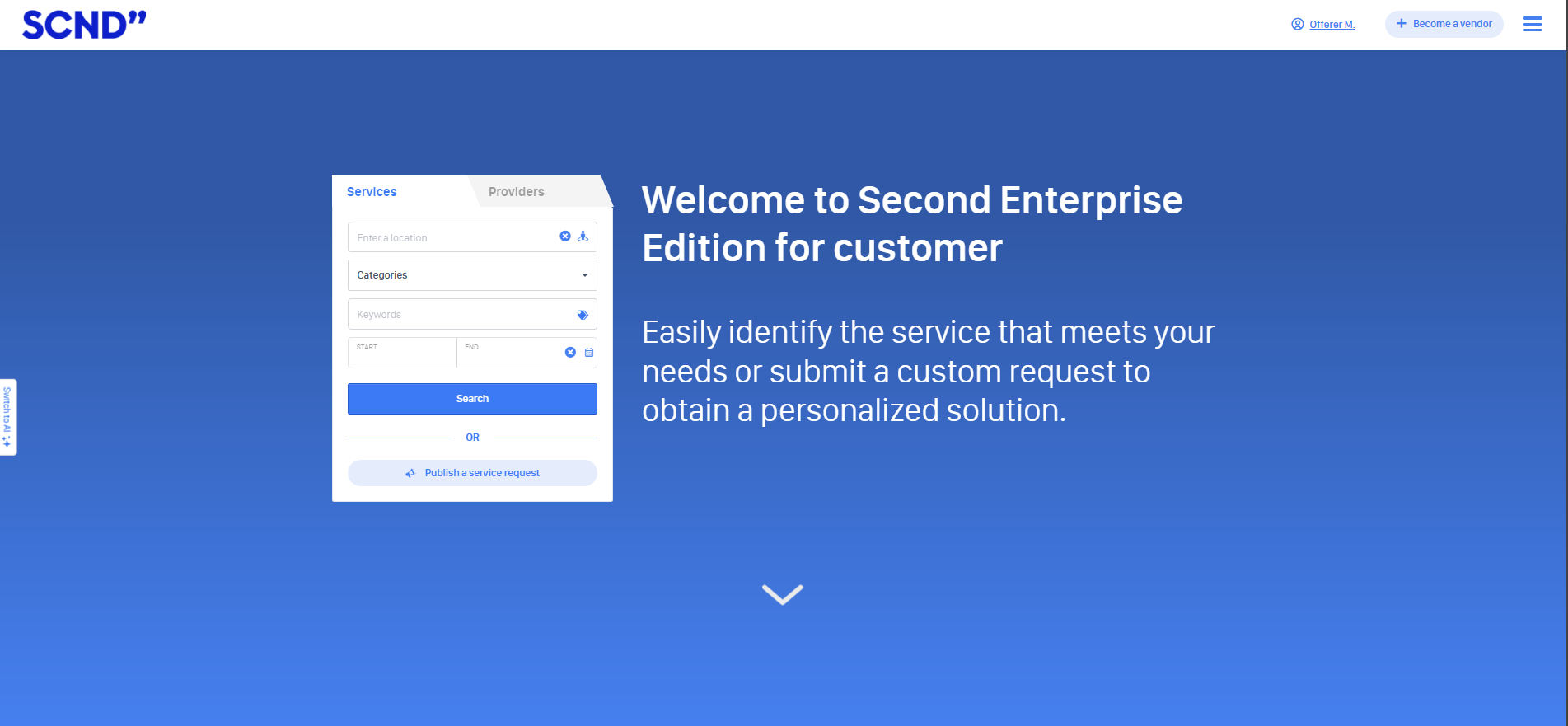
On a platform, the interface text is a text that can be translated.
Example of interface text (figure 1&2) that is manageable on the homepage.
Figure 2
### SBO part
The clear cache button is at the top of the page (figure 3).
Figurre 3
Clear cache: Caches are information saved by a web browser and can also be by a server to load pages and information faster.
Click “*Clear Cache*” at the top of the page to display the modifications that have been done.
Clearing the cache of the web browser deletes all the information saved on the cache and displays the new pieces of information that will be saved in the new cache.
In our case, the server has a cache. It is important to clear the cache when there are new translations made. The modifications done on the translations will then be visible.
In the search bar (figure 4) at the top of the page, the super-administrator can search for an interface text by writing the words in it (or the translation key) and see the search result page.
Figure 4
The super-administrator can see the list of all the interfaces text available on a platform.
For each listing block (figure 5), there is:
* The translation key
* The interface text value
* The button “edit”
Figure 5
## Update the interface text
To update/edit an interface text:
1. Search in the search bar the interface text to modify
2. Select the result and click “edit” on the bottom right corner of the interface text block
3. Make the modifications and click “ok”
4. Verify the new interface key value on the related location (Clearing the cache is needed in production)
{% hint style="success" %} Do not forget to clear the cache
{% endhint %}
### Multilingual
A dropdown button language allows the super-administrator to translate the information set into different languages.
To choose the platform languages by default, follow this path:
{% hint style="info" %} SBO > Others > Features > **Platform Configuration > Locales**
{% endhint %}
Click “action.edit” (figure 6) and set the languages.
Figure 6
{% hint style="info" %}
*Do not forget to set the **Default Locale** which is the default language of your platform.*
{% endhint %}
{% hint style="success" %} If there are several languages chosen but do not set values for each interface text, it will automatically be done by the Second platform (if default value exists, a text will be used. If no value exist, the translation key will be used as a value to be displayed)
{% endhint %}
{% hint style="info" %} We currently maintain the translations for only two default languages which are **English** and **French**. In case a different language is selected the translation key will be empty and the translation will be not added or provided by Second.
{% endhint %}
On a platform, there is a dropdown menu to select the language.
FIgure 7
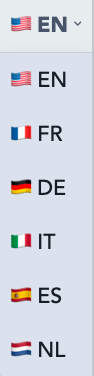
Clicking it will show the available languages in the form of a dropdown menu.
FIgure 8
Each interface text needs to be translated into the chosen language. It will be automatically displayed in the front part.
## Delete interface text
Interface text cannot be deleted
## Related resources
---
# Agent Instructions
This documentation is published with GitBook. GitBook is the documentation platform designed so that both humans and AI agents can read, navigate, and reason over technical content effectively. Learn more at gitbook.com.
## Querying This Documentation
If you need additional information that is not directly available in this page, you can query the documentation dynamically by asking a question.
Perform an HTTP GET request on the current page URL with the `ask` query parameter, and the optional `goal` query parameter:
```
GET https://features.scnd.com/v2.0/superadmin/contents/interface-texts.md?ask=&goal=
```
`ask` is the immediate question: it should be specific, self-contained, and written in natural language.
`goal` is optional and describes the broader end goal you are ultimately trying to accomplish on behalf of the user. GitBook uses it to tailor the answer towards what is most useful for that goal.
The response will contain a direct answer to the question and relevant excerpts and sources from the documentation.
Use this mechanism when the answer is not explicitly present in the current page, you need clarification or additional context, or you want to retrieve related documentation sections.